Episode 024 Full Transcript — What Is Cognitive Bias (And How It Shapes Your Decisions Without You Noticing)
EP024
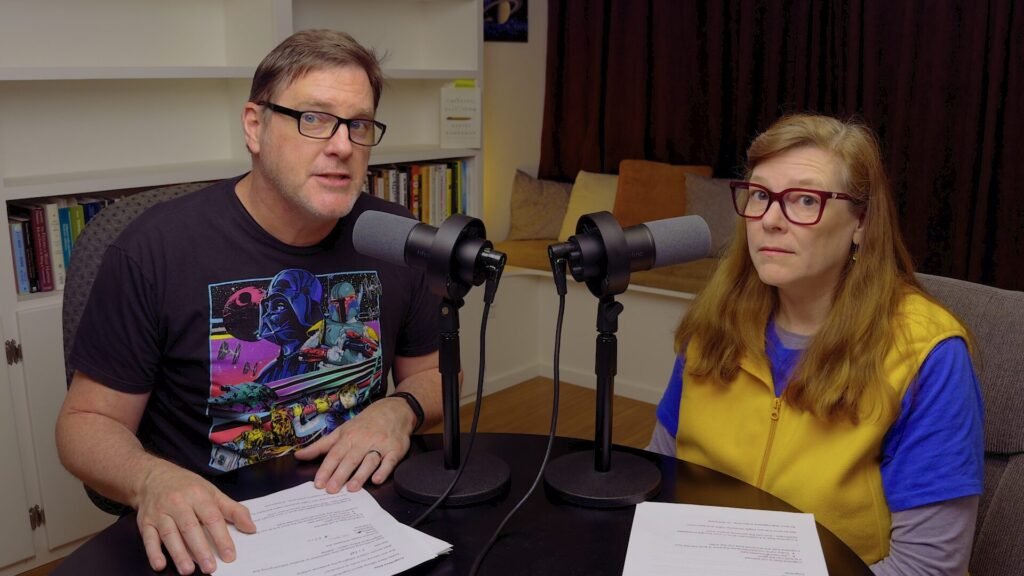
This page contains the complete transcript of the Full Mental Bracket episode 24 on cognitive bias, examining how the brain uses mental shortcuts to produce quick answers, why those answers can feel right even when they are wrong, and how these patterns influence decision-making without conscious awareness. The conversation explores how cognitive bias is built into the structure of thinking, how concepts like the curse of knowledge distort communication, and why the brain prioritizes speed and efficiency over accuracy.
For the structured psychological framing, thematic breakdown, and applied interpretation of these ideas, see the full episode analysis here:
→ What Is Cognitive Bias (And How It Shapes Your Decisions Without You Noticing)
Topics Discussed in This Conversation
- How cognitive bias is built into the structure of the brain
- Why mental shortcuts exist (energy, efficiency, and survival)
- The difference between fast thinking (System 1) and deliberate thinking (System 2)
- The curse of knowledge and why understanding is hard to communicate
- How overconfidence and incomplete information lead to thinking errors
- Why slowing down improves decision-making accuracy
- Topics Discussed in This Conversation
- [00:00] – Why Your Brain Gives Quick Answers (Mental Shortcuts Explained)
- [02:57] – What Cognitive Bias Actually Is (Definition)
- [05:10] – The Curse of Knowledge (A Common Cognitive Bias)
- [14:42] – Why Your Brain Relies on Mental Shortcuts (Energy + Efficiency)
- [16:18] – System 1 vs. System 2 Thinking
- [18:55] – How To Slow Down And Reduce Cognitive Bias
- [24:27] – Applying Better Thinking To Real-Life Decisions (Avoiding Thinking Errors)
[00:00] – Why Your Brain Gives Quick Answers (Mental Shortcuts Explained)
Brent: I am going to tap out a song for you, and I’m such an excellent tapper, you are gonna know what song I’m doing.
Camille: Okay.
Brent: Are you ready?
Camille: I’m ready.
Brent: Here it comes. You have no idea? Your brain is constantly trying to help you. It gives you quick answers, fills in missing information, and helps you move through the world without having to stop and think through every decision. And most of the time, that works. But sometimes these shor Right.tcuts can lead you to the wrong conclusion while still feeling completely right. In this episode, we look at what is cognitive bias and how it’s built into your thinking, why your brain takes mental shortcuts and where they can fail you, and how to slow down and promote more accurate thinking. I’m Brent Diggs, and this is The Full Mental Bracket, where science and storytelling meet to help you level up and tell a better story with your life. Good time period, Bracketeers. We’re back at you with another episode. And today we’re talking about cognitive bias.
Camille: Yellow.
Brent: Yes, your love for yellow might be interpreted as-
Camille: I meant, hello.
Brent: I don’t think it’s technically a cognitive bias, but it is a mental dysfunction of some kind.
Camille: It’s a mental function.
Brent: Yes, it’s a preference, yes. So we’re coming back. We’re talking about cognitive biases. Back on episode 20, we talked about just regular biases and promised to delve into cognitive biases. And we are keeping that promise.
Camille: We sure are.
Brent: As we do. As we do. We deliver.
Camille: Yes, absolutely.
Brent: So as you may or may not recall, bias is leaning towards one conclusion or another without giving due diligence to every option. It’s the way that your brain slants towards certain answers.
Camille: And everybody’s brain does this.
Brent: Yes.
Camille: There’s no, there’s no exceptions to the rule.
Brent: Yes. We’re not picking on you particular. It’s the group you.
Camille: Or you. Well, maybe we’re picking on you a little bit, but not, not you.
Brent: Well, I mean, the yellow bias is particular to some people, not so much everybody, but that’s okay.
Camille: Okay.
Brent: I love you for it.
Camille: Okay. Thank you.
Brent: There you go. So to quickly review, there are several types of bias. There are social biases. There’s systemic bias, algorithmic bias, and as we mentioned, cognitive bias. We’re not going to go over those today. Go back to episode 20. Rewind it. Watch it. Listen to it. Let it soak in. You’ll know all these biases.
Camille: That’s right. And of course, there’s also the yellow bias, which is actually a good bias.
Brent: Right. And then there’s an additional bias of always talking about the yellow bias. It’s going to be recursive and kind of compound and stuff.
Camille: Well, you know, in some of the biases, you know, it talks about if you hear things over and over again, your brain starts to believe it. So I want everybody to know that yellow is the best color ever. Maybe if I say it a lot, like people will believe it.
Brent: I thought you were going to confess who turned you on to yellow and who started the yellow cult all those years ago. But that’s no, no, you’re starting your own yellow cult. That’s how this is working. OK.
Camille: Go yellow.
[02:57] – What Cognitive Bias Actually Is (Definition)
Brent: All right. So it’s important to note that cognitive biases are not learned. They’re not something you picked up from your parents or your school. They’re not bad information. They’re actually part of the structure of the brain. Your brain is wired to take shortcuts and they fire automatically without you asking to every single time. It’s kind of like if you had a crooked saw and then all you could make was crooked cuts because it was built into the structure of the tool. Not that your brain is broken, but it just it defaults to these shortcuts all the time and if you’re not aware of it you’re going to be taking these shortcuts and they’re not always bad but sometimes they are and they’re they’re wrong just enough to really mess you up.
Camille: That’s right.
Brent: So they’re built into the structure of the mind. They’re systematic.
Camille: Systematic. Ok. They’re systematic.
Brent: They’re not systemic. They’re systematic. They’re built into the system. They’re part of the steps of the brain. The brain says, you have a question in your mind. You have this instinctive, intuitive answer. You’re like, that’s got to be right. And then, but if you take time to actually think again and flip into system two, then you might have a different, more accurate answer.
Camille: So you got to do the research.
Brent: Well, you gotta do the research, but sometimes you just gotta take time. Part of it is just being rushed. This easy answer pops up, like we talked about in episode 20. Your first answer feels right, and sometimes that’s good enough. Like, well, that’s close enough, let’s work. But sometimes, if you’re calculating a house mortgage or you’re trying to figure out some technical thing, you better really dig in and fire up your system, two, and do the long division and figure it out. All right, so people who’ve done a lot of research on bias, you could say the biggest names in bias are…
Camille: The popular people.
Brent: The popular biases are Daniel Kahneman and his partner Amos Tversky. They literally wrote the book on bias, several books. Their earlier research on biases, cognitive biases and heuristics set a whole new field of study, and that people are still talking about today. Case in point.
Camille: Yeah, they should be. It’s important for people to understand that they have bias and to work to overcome.
Brent: Some people, scientists refer to them as cognitive illusions, just because they’re so convincing.
Camille: Persistent, if you will.
[05:10] – The Curse of Knowledge (A Common Cognitive Bias)
Brent: Yes, they are persistent. So, for example, one cognitive bias is the curse of knowledge. Perhaps this has happened to you.
Camille: Yes, as a matter of fact, it has.
Brent: Well, let’s explain it first.
Camille: And it’s, it’s, it is a curse.
Brent: It’s a curse.
Camille: It’s a curse.
Brent: It’s a curse. So the curse of knowledge or the expert’s curse is basically once you understand something, it’s hard to not understand it. It’s hard to compensate and put your mind into what it was like before you knew that and to try to figure out what other people think that don’t know what you know.
Camille: It’s kind of like when you’re at work, and you contact the IT department, and you say, hey, I have this problem, and…
Brent: Go ahead. Somehow this doesn’t feel hypothetical to me.
Camille: It’s kind of like. Kind of like. Kind of like.
Brent: Tell us, tell us, tell us.
Camille: And you say, hey, I have this issue, and the IT guy says, well, just go here and do this. And you’re like, well, hold on. you’re saying go here, but I don’t know where here is. And you need to start at the beginning for me because I’m not in your head. I don’t know what you know. I don’t know that that’s a good place to start. I need to actually start at the screen that I’m on. So let’s have a conversation about where I am at so I can get to where you are so we can actually start at the same place.
Brent: But these people aren’t trying to be difficult. They just know so much. They just assume everyone knows it. It reminds me kind of like the old country way of giving directions. Well, go to where Johnson’s Barn burned down in the 40s and then take a left over to where that thing used to be over here, you know, where the dead cow died. And you’re like, no, I don’t know any of these references. How am I ever going to find this thing?
Camille: Exactly.
Brent: It reminds me of that movie Funny Farm with Chevy Chase, right? So these movers are traveling overnight, they’re trying to figure out this janky map that some idiot drew and nothing’s to scale and nothing makes any sense and none of the locals will give them good directions and he gets there and Chevy Chase says, what took you so long? I drew you a perfectly good map!
Camille: Exactly.
Brent: And then they want to kill him.
Camille: Yes. Because it was a perfectly good map to him, but the stranger, like, I have no idea what these lines even mean. Like, what are you doing on this piece of paper? Who authorized you to use a pencil? Stop it. You know, another thing that happened one time, this actually happened to me, is that my mom took me to my first community Easter egg hunt. And we were really excited about it, I was excited about it, we sat there.
Camille: Oh yeah, there’s eggs, there’s other kids, there’s prizes I’m sure, so fun, candy, oh yeah.
Brent: But I’d never done it as a community before. We kind of did it in the backyard, I knew how this thing worked, right? So we went and we boiled the eggs and we dyed them and I was very, selective about the color selection and everything was, I loved it.
Camille: You were very artistic.
Brent: I love these eggs. I memorized the color scheme of these eggs because I knew those could be important. So we handed over these eggs and somebody took all of the eggs and laid them all out. And then they said, go. And I ran out there and I walked, I ran past these plastic eggs. My mom’s yelling at me, get the eggs, get the eggs. But they weren’t our eggs.
Camille: That’s right.
Brent: Because I knew.
Camille: Why would you get other eggs? Just yours.
Brent: I knew you had to go and get only your own eggs out of this thing. Some little kid grabbed some of one of my eggs and started a fist fight up there. Give me my egg. And there was violence, there was tears.
Camille: There was non-violence.
Brent: There was tears.
Camille: There was tears.
Brent: My mom stormed on there, what are you doing? I was like, I’m trying to retrieve the eggs. And I was like, that’s not how the game works. Like, no one told me. Everyone knew how this game worked except the kid. And no one bothered to explain to the kid what was supposed to happen. It was a curse of knowledge.
Camille: A curse of knowledge.
Brent: Everyone from a gazillion Easter’s, they all know how this works, except for that little short guy over there who’s crying in the corner.
Camille: Because he wasn’t able to get his own eggs that he worked really hard to paint.
Brent: I memorized those eggs. I memorized those patterns so I could find them.
Camille: That’s right.
Brent: Even in somebody else’s basket. Give me that. It was an incident.
Camille: There you go. That’s funny.
Brent: So as you integrate information and experiences into your mental models of the world, it stops being a separate piece of information and it gets baked into there. And then you just can’t, you can’t mentally take it back out again. It’s part of what you know. It’s part of how the world works. And so it’s really hard when you’re trying to explain it to someone else.
Camille: Okay, so it’s also kind of like, for those who have ever looked at different logos, different things, the FedEx logo has an arrow between the E and the X. And for people who’ve never seen that arrow, they look at the FedEx sign all the time and they never see it. But once you see it, you can’t unsee it. You get one reveal. That’s it. Once it’s been revealed, it’s over. You always see it.
Brent: I looked at that logo a bunch of times and you pointed it out to me and I felt really dumb. Like, it’s been there the whole, they just put that in there. Like, no, no, it’s been there the whole time. It’s been there for years. Like, no, no, I would have seen it. Like, no, it’s been there the whole time.
Camille: That’s right.
Narrator: This is Full Mental Bracket. – 10:13
Brent: All right, so we are going to demonstrate this for you, my dear Bracketeers, with an experiment. And you, my guinea pig, I am going to tap out a song for you.
Camille: Okay.
Brent: I’m going to be humming along in my head, but I’m going to tap out on the table for you to hear the song. And I’m such an excellent tapper, you are going to know what song I’m doing.
Camille: Okay.
Brent: Are you ready?
Camille: I’m ready.
Brent: Here it comes.
Camille: Nope, not a clue.
Brent: You have no idea?
Camille: No.
Brent: Now, in my head, all I could hear was, Jenny, Jenny, who can I turn to? Eight, six, seven, five, three, oh, nine. I heard the whole band. I heard the harmonies, I heard the guitars, I heard the bass. All you heard were these knocks on the table.
Camille: Yeah, and I didn’t get it. Are you ready for yours?
Brent: Oh, you got one for me?
Camille: I got one for you.
Brent: No, you were the guinea pig.
Camille: No, no, I got one for you.
Brent: I’m the guinea pig now?
Camille: I got one for you.
Brent: Okay, I’m ready. Shave and haircut two bits. I don’t know. What was that?
Camille: Happy birthday to you. Oh, see, that was a really common one and I didn’t get it.
Brent: Yeah. Well, I’m not the only one who didn’t get it. This was an experiment done by Elizabeth Newton. She pulled a bunch of people together and had them tap to each other. But before they tapped, when they got their songs all together and they were practicing their taps and they were ready to go, Elizabeth pulls them aside and said, so how confident are you that your partner’s gonna be able to understand your song? And they said 50% of the time. 50% of the time, they were being generous. 50% of the time. I’m such a great tapper, they should get it every time. But because they’re dumb, maybe 50% of the time, they won’t get it.
Camille: It’s not my tapping.
Brent: They won’t get it. So what happened when the results came back? 2.5% of the time.
Camille: Wow.
Brent: Basically, when people got lucky, they’re like, was that a happy birthday?
Camille: Like, oh! Wow.
Brent: That’s one of the only two songs I know. That’s the only reason I got it.
Camille: Oh my gosh.
Brent: So it’s like 2.5% of the time.
Camille: That’s really bad.
Brent: Yeah.
Camille: That’s really bad. But it does really demonstrate the fact that we expect people to understand things that we understand, and yet we’re only giving them a part of, or they’re only getting from another source, a part of the picture, and so they’re not understanding.
Brent: Well, we kind of mentioned this a little bit in episode 11, that much like the spotlight effect, the curse of knowledge is an egocentric bias. It’s like your view of the world affects your judgment so powerfully that it’s very hard. You know you need to compensate for other people’s perspectives, but no matter how much you compensate, it’s not enough. It’s like, I’m gonna dumb this really, really dumb, so you guys that don’t know about this will know what I’m talking about. And you just, nope, still, still doesn’t. And it’s not about them being dumb, it’s just like, you know so much, it’s hard to pull that out of your knowledge bank.
Camille: It gives me a greater respect for teachers who can really teach concepts and things that we just think that we know, or the teacher thinks they know, and they can bring it to a point where anybody could understand it.
Brent: Well, subject knowledge and teaching ability are two different things. You can be an expert at a field and still be terrible at explaining it to other people. I mean, something we’ve mentioned on the show before was the Feynman technique, where it’s like, if you think you understand something, explain this to a child. Simplify it enough, take out all the jargon, all the shortcuts, and explain this to a child, and you will quickly realize how well you don’t know it. There’s gaps in your understanding, go back, think about it, find another child, explain it again, repeat and wash and lather and rinse until you can explain it without gaps very simply.
Camille: Yes.
Brent: His point was we rely on a lot of ideas and jargons and shorthand, and we don’t even realize to ourselves how poorly we actually understand things. The curse of knowledge is just one of many cognitive biases. We’ve mentioned some of them, the spotlight effect. We mentioned some other ones before in episodes. In episode nine, we’d mentioned the negativity bias. We’ve mentioned the whizzy addy. We’ve mentioned the hedonic treadmill. There are a lot of, your brain does a lot of shortcuts to try to help you, and there’s a very long list of them all. But once again, they’re not bad. They’re like predictive text in your phone. Most of the time, it can guess what you’re trying to say, but sometimes it’s like, I was trying to say salami. I was trying to say salami, stop helping me. When it goes wrong, it goes wrong bad. So we’ve established that cognitive bias happens to everyone. No one gets to opt out of it. It’s built in the system of the brain. But why is it? Was the brain just built badly, do you think?
[14:42] – Why Your Brain Relies on Mental Shortcuts (Energy + Efficiency)
Camille: I don’t know if it’s bad, but the fact that you were telling me that the brain operates at only 20 watts of power is insane to me. You were saying that the microwave is 1,000 watts and our brain is 20 watts. That’s all we get?
Brent: Even the coffee maker pulls more power than our brain. Your brain is a 20 watt meat computer.
Camille: Meat?
Brent: Yep, built out of organic tissue.
Camille: Salami, we’re back to the salami.
Brent: Built out of organic tissue, it’s analog rather than digital. I guess some of the signals flip off and on like digital ones, but it’s analog, it’s wet, it’s full of fluids, it has to rest each night. In a computer, if your computer’s not going good enough, you can put more memory in, you can put a bigger power supply, a bigger fan, you can really crank up the heat and cool it off. The brain, you’re stuck at 20 watts.
Camille: Amazing.
Brent: That’s all the juice it’s ever gonna pull. So because of this energy budgeting, your brain tries to not think too hard. Your brain tries to protect you from thinking all of the time. This explains to people.
Camille: It’s like, I got to protect my 20 watts. I don’t got a lot. I got to protect it.
Brent: Now think about some people who don’t think very much. And it kind of explains some things. Their brains are extra protective. I can’t think about that.
Camille: So are you saying that instead of calling people stupid, you just say they’re in power saver mode?
[16:18] – System 1 vs. System 2 Thinking
Brent: That is a great one. You are a great budgeter. You are budgeting that mental energy in case you might actually have to think someday, you’re saving it up for a rainy day. Well done, sir. This is good, this is good. This is the basis of the system one and the system two that we talk about. The system one is low energy, you don’t feel any effort, the answer just comes to you like magic. This is your brain’s main operating system and it tries to get you to operate that way all the time to try to save energy. And then if an emergency happens, if there’s a bear in the woods or something, you don’t sit there thinking, trying to do long division. Well, logically, do we take Path A? You run. You run with these feelings and these hormones and these things you’ve got.
Camille: Run like the wind, baby.
Brent: And you’re just gone. And once again, this works really good most of the time, but sometimes it doesn’t.
Camille: When doesn’t it work right?
Brent: Well, like if you’re trying to build a rocket, or if you’re trying to budget a project, or you’re trying to logically design a system, the first thing that comes to mind is usually not the best way to do that. You gotta mentally, once again, I’ll say this again, your brain defaults to system one, and you have to say, stop, pause, grab that gear shift, shift into system two, and say, all right, now with my thinking cap on.
Camille: So how would you start to build a rocket?
Brent: Well, I would start with the color selection. It would have to be yellow.
Camille: Oh, you are so smart. You must be operating on all 20 watts today. I’m good
Brent: No 19 and a half over here.
Camille: No.
Brent: No. So the system too is what scientists call effortful. You feel the effort of that thinking. This is why learning something new.
Camille: Like a language. When I was in Costa Rica, I was so tired every single night from all day long having to, I felt like my brain was just translating all day long. And I was exhausted by the time I got to the nighttime.
Brent: It’s not your imagination. That’s a signal from your brain telling you that you’re using all the brain’s resources. It’s trying to bribe you to stop thinking so hard. You feel how tired you are? You wouldn’t be so tired if you’d stop learning. It’s just kind of your brain’s survival system. It’s like, ah, gonna overheat us. Let’s slow down here. We only got 20 watts to work with. And so you feel that effort, it builds up and you eventually you’re motivated to stop and take a break, go for a walk, take a nap. But it’s your brain’s way of letting you know that you’re in system two high effort mode.
Camille: Gotcha. Naps are good.
Brent: Naps are my favorite.
Camille: Yes.
Narrator: This is full mental bracket. – 18:51
[18:55] – How To Slow Down And Reduce Cognitive Bias
Brent: So we got some good news and some bad news. The bad news is that you can’t fix cognitive bias.
Camille: That is bad news.
Brent: The good news is that you can learn to identify it and compensate for it.
Camille: That’s very true. There are times when I am online, I’m looking at different things, researching or whatever I’m doing, looking up, and then they’ll have different… like news stories that’ll pop up, and the headlines are always to try to either instill fear, to catch your attention, and sometimes they’re not even true, like the headlines are not even true.
Brent: That’s true.
Camille: So, to bypass that, if I see something on a news headline that they want me to click on, I will actually open a new tab.
Brent: That’s a good idea.
Camille: And I will type in, is something happening right now in Chile? On the news. And it’ll give me the top news stories that are happening with items in Chile.
Brent: So you don’t click on the link itself.
Camille: Correct.
Brent: You don’t reward that business model.
Camille: Exactly.
Brent: You don’t get scammed.
Camille: Yep.
Brent: You don’t go to some hyper-partisan site.
Camille: You got it.
Brent: You do your own research.
Camille: Even if it’s in yellow, I don’t click it.
Brent: Now, I don’t know if that is a specific cognitive bias. There could be. There’s hundreds of them. That could be like the yellow clicky, netty effect or something like that. But it’s that same thing of switching from system one to system two. It’s that same principle at work. It’s like your system one is clickbait, rage bait. Oh, they said, oh, no, they didn’t. And then you click on that thing and then you’re either led to a scam or you’re led to the super misinformation site. You’re like, OK, I feel that. I feel that pull but i’m going to say no go over to the side switch into a different gear of actual going upstream and actually researching the research underneath that story get it from a reputable source and see what’s really going on and that’s a good parallel to how to deal with cognitive biases. It’s like i feel like this has got to be the right answer take a pause find some different gears, find some different tools, look at it from a different angle, get a second opinion, slow down.
Camille: Second opinions are good. Your tribe is so helpful. You gotta have a good tribe. We’ve talked about that many, many times before, but it’s crucially important that you have people in your life who are further along in the journey than you are who can speak into your life and that you have people not as far that you can speak into their life.
Brent: So consulting your tribe is helpful. It’s not as useful as social biases and stuff where people can be completely wrong and you can have a different bias that can kind of compensate for it. Like if we had a friend, a misguided friend, who didn’t love Canadian bacon and Hawaiian pizza.
Camille: Bless their heart.
Brent: We would have to really go above and beyond to really to help them and bless their heart and teach them the error of their ways.
Camille: Yeah.
Brent: But you can kind of compensate that. But with cognitive biases, we all pretty much have the same cognitive biases. So it’s more about your friends who have learned to identify them and to compensate for them. And they can say, hey, I know that feels like the right answer, but let’s think about this again.
Camille: Yes.
Brent: And so your friends might also encourage you not to overreact, especially with the clickbait thing that we talked about before, where it’s like, oh, this can’t be, can’t be. We have to learn. A rule we try to encourage our people on the show all the time is to be curious.
Camille: Not furious.
Brent: Not furious. If something seems crazy, don’t get mad, don’t get irate. How dare they think that, say that, do that. Like, why would someone do that? Or did they do that? Or am I just being lied to from the beginning?
Camille: That’s true.
Brent: Let’s just stop and like, huh, that’s interesting. Let’s think about this for a second. Let’s talk to some people. Let’s ask some questions. The way you’re coming at this seems really odd to me. Why? Why do you? Why? What’s your reason behind that? And even if you don’t agree with their answer, you understand the problem better because you’ve seen it from a different angle.
Camille: True.
Brent: So time factor plays a big part of cognitive bias. A lot of cognitive bias has happened because you’re in a rush. You don’t have time to flip over into system two. You take this intuition, this supplied answer, because you don’t have time to think about it. So anytime that you can take time and deliberate on a decision or a choice, that’s going to be in your best interest, unless there’s a bear attacking you. If there’s a bear charging you, then maybe you go with, yeah.
Camille: Again. That’s a run situation.
Brent: But a lot of times, you’re not well served by rushing into things. And salesmen and scammers know this.
Camille: They’re horrible.
Brent: That’s why they want you to give a decision today. Like, you gotta tell me right now. Don’t you dare leave the car lot. You have to make the decision right now. It’s like, no.
Camille: Oh, the sale isn’t gonna be there tomorrow. You gotta get it today.
Brent: I’m gonna think about it. I’m gonna sleep on it. I’m gonna activate system two and find what’s the best deal for me, not the best deal for you. Except for you, we’re in the same, we’re in the same. Your best deal is my best deal.
Camille: Absolutely.
Brent: Yeah, I wouldn’t dream of thinking you were a salesperson. I’m sorry. So how do we connect this to our story framework? As we’re always trying to remind people.
Camille: With Legos?
Brent: Yes. As we’re always trying to remind people, your life is a story and you are the protagonist of that story. You have to be active, you have to make active choices. And if you’re not living a very good story, you need to take steps to make, to change that.
Camille: Lincoln Logs.
Brent: Yes, you need to switch from Legos to Lincoln Logs. That’s exactly the situation that we need.
Camille: Well, you know, the wood is better than the plastic.
[24:27] – Applying Better Thinking To Real-Life Decisions (Avoiding Thinking Errors)
Brent: Right. So, I mean, and cognitive biases can affect you in a lot of ways, especially if you’re the critical thinking and the long term decision stuff. If you’re if you’re going through cognitive biases instead of actually deliberating on your decisions, you can make some bad financial decisions. You can make some bad relational decisions. It’s hard to build a legacy if you’re going broke all the time, financially or relationally, because you keep making the same mistake every time.
Camille: Yeah, we’ve seen people in those patterns. They make the same mistake over and over and over again. They’re not learning from that mistake. They’re not growing as a person. They just keep, I don’t know, maybe it’s called the lazy way out because they keep leaning into that system one instead of moving to system two. And, you know, they just keep getting it wrong.
Brent: There could be a lot of reasons for that. And honestly, cognitive bias is not the only reason that you repeat patterns, but it can be one reason. And so if you can eliminate that, you’re already doing better. So as we mentioned, the curse of knowledge is an egocentric bias. There’s a family of egocentric biases, and they all rely on you not being able to communicate clearly what’s in your head or estimate what’s going on someone else’s head because you’re busy thinking about how you think and you can’t communicate clearly. One would be the curse of knowledge we’re talking about now. We’ve talked about the spotlight effect. If you think we tend to think that more people agree with us and our opinion is more popular than it really is, that’s the false consensus effect. We tend to think that people understand what we’re thinking and how we think better than what they actually do. Maybe you don’t explain things very well because I assume you know what I’m thinking. That’s the…ah.. That’s a transparency effect. There are all kinds of cognitive biases.
Camille: Sounds like there’s a lot of effects.
Brent: Yeah. And the thing is, and those all go back to communicating more clearly, questioning your assumptions, clarifying your communication, trying to explain it like a fifth grader, just slowing down and doing the work to communicate with people. So you don’t cause difficulty in your tribe and alienate your friends or just have minimize the misunderstandings.
Camille: I think the key, again, as you said, going back to be curious, not furious, asking the questions, and making sure that we’re trying to understand.
Brent: Right. Like, where were you? Oh, I thought you meant the other state of Florida. It’s like, no, no, no. You got to explain. Where were you? So we have a few takeaways.
Camille: We do indeed. Absolutely. Are you aware of any biases in your thinking? We’ve asked this before. Of course, if the answer is still no, please go back and watch episode 20, because it should still not be no at this point.
Brent: Because you’ve got them.
Camille: Everybody’s got them. I understand that you do.
Brent: If you don’t see them, it’s not because you don’t got them.
Camille: That’s right.
Brent: All right, do you have a method or a decision framework to help you slow down and shift into logical thinking?
Camille: Think back to a time when you were absolutely sure, only to find out I wasn’t really right. Remember that false sense of certainty? How long would you have gone believing that you were right?
Brent: Think about areas in your current thinking and decisions where you could be just as wrong.
Camille: Is it okay in your mind to be wrong? It should be, but is it? Can you admit mistakes? If not, how are you ever gonna learn and improve?
Brent: If you’re afraid to fail, you can never learn. That’s all we have for you this time. We’ll be back soon. Thank you for joining us.
Camille: Bye.
Announcer: Full Mental Bracket podcast hosted by Brent Diggs. Logo by Kolby Osborne. Music by Steven Adkinsson. Learn more at FullMentalBracket.com. This is the Full Mental Bracket.
 Spotify
 Apple Podcasts
 YouTube
 Pandora
 iHeartRadio
 Amazon Music
 Overcast
Brent A. Diggs is the host of the Full Mental Bracket podcast, where psychology and storytelling are used to examine how people make decisions, handle responsibility, and shape the direction of their lives.
Each episode focuses on the kinds of situations people get stuck in—uncertain choices, pressure, strained relationships—and what it looks like to respond to them in a way that actually moves your life forward.
Learn more about the Narrative Ownership framework behind these ideas here.