Episode 023 Full Transcript — The Family Pattern That Keeps You Stuck | Back to the Future Psychology
EP023
This page contains the complete transcript of this Full Mental Bracket episode 23 on Back to the Future, examining how family patterns, conflict avoidance, and learned helplessness can keep people stuck in inherited roles. The conversation explores how identity is shaped through repeated patterns, why passivity can spread through a family system, and how change begins when someone decides to act differently.
For the structured psychological framing, thematic breakdown, and applied interpretation of these ideas, see the full episode analysis here:
→ The Family Pattern That Keeps You Stuck | Back to the Future Psychology
Topics Discussed in This Conversation
- How family patterns shape behavior over time
- Learned helplessness and the fear of confrontation
- Conflict avoidance as an invisible trap
- Why change cannot be outsourced
- Identity change through decisive action
- Why you do not need to fix the past to build a better future
- Topics Discussed in This Conversation
- [00:00] Family Patterns and Feeling Stuck
- [02:02] Why Back to the Future Resonates Psychologically
- [07:40] Limiting Beliefs and Family Identity
- [10:59] Emotions as early indicators, not final authority
- [15:50] Conflict Avoidance and the Invisible Trap
- [20:20] Disrupting Patterns Through Action
- [24:57] Why Change Cannot Be Outsourced
- [26:47] Identity Change Through Decisive Action
- [32:44] Why You Don’t Need to Fix the Past
- [47:26] Becoming the Protagonist of Your Life
[00:00] Family Patterns and Feeling Stuck
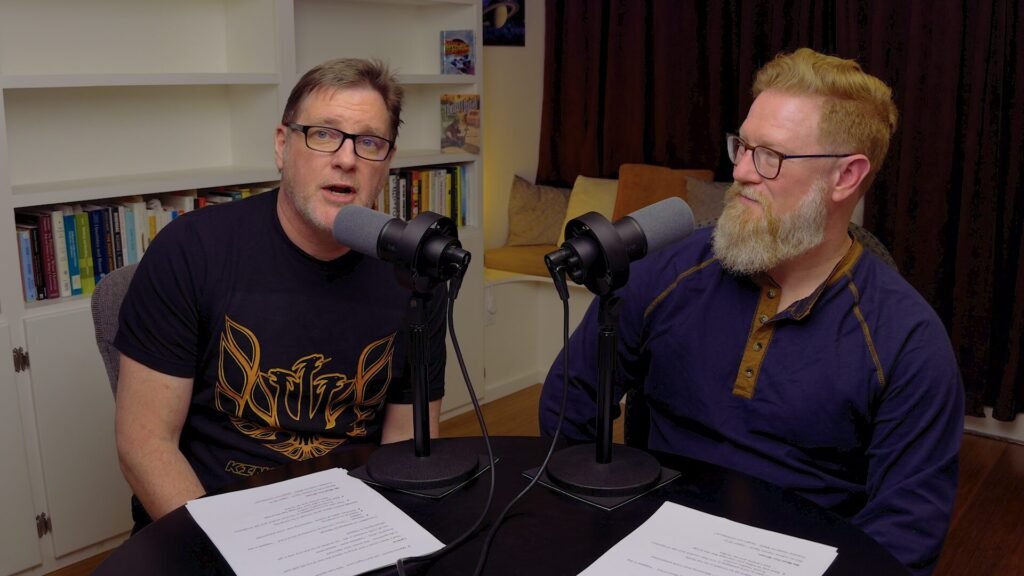
Brent: Have you ever felt stuck in the life your family forged for you? Felt doomed to repeat the patterns you’ve learned about emotions, conflict, and avoidance? What if the real problem is the story you’ve learned from them, that this is who we are, and that this is all we do? Today, I’m joined by Andrew Chandler as we look at the film Back to the Future, and what it teaches us about avoidance, family dynamics, and learning to be the protagonist of your own life. Join us as we discover that you don’t really need a time machine in order to build a better future. I’m Brent Diggs, and this is The Full Mental Bracket, where science and storytelling meet to help you level up and tell a better story with your life. Good time, period, Bracketeers. We’re coming at you with another episode. Join us today in the Stunt host chair is Andrew Chandler.
Andrew: Hey.
Brent: Andrew Chandler is an artist in every sense of the word. The man is an illustrator. He’s an actor. He’s a voice actor and he is a writer.
Andrew: That’s right.
Brent: As well as a movie fan.
Andrew: Yes, definitely a movie fan.
Brent: In fact, Andrew has written this very book.
Andrew: That’s right. Tell us about it. Well, this is my second addition to my postmodern fables collection. The first one being Terry Fails. This one’s called Taylor Flails. They’re some of the same characters, but they’re more postmodern fables. Stories that you may be familiar with, but are kind of twisted and turned upside down and inside out. And I’m actually working on the third one right now.
Brent: A fun retelling.
Andrew: Yes.
Brent: Of classic tales.
Andrew: Yes. Fun. Sometimes a little dark. Sometimes a little weird. But you might recognize them if you squint your eyes hard enough.
Brent: Nice. So where can we find these?
Andrew: So you can find them right now through my Lulu bookstore. I’m working to get them on Amazon, but I’ve got to fix some of the criteria in order to do that. So you can go to my website, andrewchandler.net, and there will be a link there for the books.
Brent: Excellent, excellent. Well, as good as Andrew’s books are, that’s not what we’re talking about today. We’re talking about Back to the Future.
[02:02] Why Back to the Future Resonates Psychologically
Andrew: That’s right.
Brent: The movie from 1985.
Andrew: Yes. Yeah. Yeah. One of my favorites, written and directed by good old Robert Zemeckis, who seems to be able to stay relevant all these years later, produced by Spielberg. And yeah, one of my favorite movies. I’m glad we’re talking about it.
Brent: Yeah, and you know, a thing that I think we have to get out of the way right off the bat, you see a lot of memes today, is like, you know, I was conscious and alive and actually in high school in 85 when this came out. And 30 years seemed like a long time. 1955, those were old people. Those were dinosaurs. It was the dark ages. And so now that it’s over 40 years now from when this movie was recorded in 85, It seems unfair that time has traveled that fast.
Andrew: Yeah, yeah, long time. Yeah, I was very young when I first saw this. I saw an edited TV version where some things were cut out, some of the language was changed, but watched it over and over again and thought it was so cool, thought Marty McFly was the coolest guy ever. Wanted to ride my skateboard through the streets, you know, wanted to fight bullies, things like that. So, yeah.
Brent: So what’s your favorite scene of this movie, if there’s one?
Andrew: You know, I was trying to think of what my favorite scene might be now. I know when I was younger, definitely the scene where he takes the kid’s soapbox, little derby car, breaks the top off and turns it into a skateboard and is racing through the streets and running away from Biff and the bullies. That was probably my favorite scene at the time. Still a great scene. Just well filmed and exciting.
Brent: As soon as you start talking, I like, What are the odds it involves a dump truck full of manure?
Andrew: Right. A recurring character of its own in the trilogy. But nowadays, you know, having gone and watched it again recently, I’m just, you know, just floored by Michael J. Fox’s performance and his acting chops and Crispin Glover. And they’re so funny together. And I think about the scene where where George is hanging up his wet laundry and Marty’s trying to give him a pep talk and just their back and forth is just so spot on. So that’s probably one of my favorite scenes that I remember now.
Brent: So let’s kind of go through the movie. The movie opens with a shot of a whole bunch of clocks. And I didn’t quite realize it at first, but this is kind of an homage to the film, The Time Machine from 1960. And that’s the movie I saw a lot of times. It’s kind of old by today’s. It’s kind of George Powell, if that means anything to you, it’s kind of primitive special effects, but yet beautiful at the same time. And that movie starts exactly the same way. And once you start seeing the similarities between these two movies, you start a little light bulb comes on.
Andrew: Yeah, definitely. There’s lots of little throwbacks and back to the future to this movie. You can tell that the that the director and the writers were probably big fans. You know what they were doing.
Brent: So if you go and watch The Time Machine, if you go in the future, there’s two breeds of People ish humanoids. There’s the Eloy who are delicate and gentle and they’re very kind but they’re also helpless and then you have the Morlocks who are large and hairy and nasty and they pray and um eat the Eloy and it’s not a very happy story right, but as you watch, you watch Back to the Future, you can kind of see some shadows going back and forth there.
Andrew: Sure, yeah. I mean, that old movie, you know, was definitely of its time, exaggerated fears and worries about what was going to happen with, you know, just the atomic age and things like that. And yeah, so I think, you know, worst case scenario, you think about humans evolving into some primordial you know, scary monster beasts that prey on the younger and the weaker and the more beautiful. Yeah, I can see it.
Brent: Now, if you watch the like the early 2000s remake of the Time Machine, you might think that the Morlocks are like hunting predators and they show up with nets and Jeremy Irons and stuff. But in classic, in the book and in the movie, the Morlocks rely on behavioral patterns. So over the years, People were trained from they heard the air rain siren and they would run to shelter. And in millions of years in the future, when they play the siren, the Eloy run into the caves where they get ate. And so these behavioral patterns, they were like, they are not these tough guys. They’re just like, hey, I noticed how we can trigger other people’s behavior and take advantage of that.
Andrew: Yeah. Yeah. It’s very interesting. Yeah.
Brent: I hope there’s no one that shows up in this movie that does that. That guy would be a bully.
Andrew: Yeah. You don’t like seeing people prey on other people. It happens.
Brent: So when this movie opens, it’s interesting because they show Michael J. Fox’s shoes. They show the back of his jacket. They show his skateboard. I was clocking it. They don’t show his face for like five minutes. And I don’t understand that because he was like a huge star.
Andrew: Yeah. Yeah. And even when they do show it, he has these huge aviator sunglasses on. You can’t see his eyes. Yeah.
Brent: It’s like they’re making a joke over we’ve got him.
Andrew: I think so.
Brent: They’re just kind of toying with the audience.
Andrew: Yeah, definitely. Yeah. He was a huge star. Three big movies that came out that year.
Brent: Plus the tv show he’d been doing he’d been uh
Andrew: Yeah family ties was still going on yeah the guy was stretched pretty thin but still gave some amazing performances he was good.
[07:40] Limiting Beliefs and Family Identity
Brent: So we see him uh he’s late for school he shows up at school and the school principal uh states the story problem he says no McFly has ever amounted to anything in the history of this town. And impulsively, Marty says, well, history’s going to change. A little on the nose there. Yeah. Yeah. More literally than anyone realized at that moment in time.
Andrew: Yeah, there’s plenty of foreshadowing and little Easter eggs and things where you can see what’s going to unfold throughout the rest of the movie.
Brent: As I rewatch this, because I’d seen it before, but not very many times. Strangely, as I talk to my friends about their favorite movies, they turn out to be not necessarily my favorite movies. And so I get to dig them back up again and learn from them all over again. And so what’s interesting about this is that is they compare Marty to George over and over again. You see that they’re contrasted against each other. You know, you realize from the principle that Marty’s kind of in the same boat as his father George. And even before we meet George, the girlfriend compares Marty’s like you sound just like your dad. So already they’ve been thrown in contrast against each other and we haven’t even met George yet.
Andrew: Yeah. Yeah, and you see Marty pushing against that. The problems at school don’t necessarily seem to be the same, but they’re problems nonetheless. And Marty’s definitely has his own trajectory in mind, and it seems to deviate quite a bit from his father’s.
Brent: Yeah, he seems to have more agency. He seems to be a little more of a protagonist He’s not without flaws, but at least he’s not he’s not a passenger in his life, right? Yeah, not yet at least you feel like there’s a chance for him to get out, but you’re not certain how long that that window is gonna stay open.
Announcer: This is full mental bracket. – 09:24
Brent: So when we do meet George. We go home, we see him, George, in the present of 1985, and he’s being victimized. We see him humiliated and powerless. We see that there’s a Morlock in his house. There’s this big, hairy guy, Biff, just preying on his pattern, on George’s patterns of helplessness. There’s just a large predator in his house.
Andrew: Yeah. Yeah, Biff just walks all over him. Marty recognizes it right away, and it seems like George is oblivious to it, but he’s not. He tells Marty, I’m just not good with confrontation. And so Marty’s pretty upset, not just because the car is wrecked and he can’t go away with his girlfriend for the weekend, but he’s also upset that his father is being bullied and victimized once again.
Brent: It’s really egregious, man, because, I mean, if you think back at it, Biff crashes the family car while he was drinking. He takes no responsibility, blames George for loaning him a faulty car. He has George working nights and weekends to do his his work work for him so he can get look good for the bosses. And it’s so blatant. It’s so over the top. It’s so something that you couldn’t believe actually happened in real life. And you say, how could how did this happen? How could this ever get this bad? Why didn’t why didn’t somebody do something?
Andrew: Yeah. Do adults act this way?
Brent: Exactly. This seems like a schoolyard bully business.
Andrew: It does.
Brent: If only there was a time machine, we could figure out what happened with the schoolyard bully. We’d know where this came from.
Andrew: We’d figure it out.
[10:59] Emotions as early indicators, not final authority
Brent: So we look at the family there, the McFly’s, and they are stunted and beat down. I mean, the house is dimly lit. It’s cluttered. You know, I don’t know if you guys if you’re from my age bracket and you see mom show up with these dark blue wide collar, dark blue, dark red. You’re like that was 1976. In 1976, everyone was wearing red, white and blue. So in 85, she’s pulling out her 76 wardrobe, putting it on. She’s got some extra weight. She’s taking slugs of vodka. She is not doing good.
Andrew: Yes. Bicentennial. She’s not doing good. Yeah, just big bags under her eyes. She’s drinking her vodka. She’s heating up the microwave, the TV dinners and whatnot and lamenting the past. Still thinking about that dance where she fell in love with their father.
Brent: And then if you think about it, when she says that, if you watch her eyes, her mouth says one thing, her eyes says something different. And that was the day I knew we’d be together forever. And her mouth is making a Hallmark movie. Her eyes are like, that’s when the judge lowered the gavel and the prison doors closed. And that was when my life was over is I got stuck with George and then we went nowhere.
Andrew: Yeah. Yeah. You know, she, she has regrets for sure.
Brent: So if you look back more in the, you know, around the rest of the family, you know, George is wearing hair grease. He’s wearing his glasses from the 50s. You know, his older brother, Marty’s older brother is wearing his McDonald’s uniform. He can’t even get a ride to work. He’s got to take the bus to work at McDonald’s. You know, no one protests what Biff has done. They’ve given up fighting. They’re like, Biff is like a lion. He’s a predator in their life. There’s no point fighting. We fought before. Nothing ever changes. They’ve given up.
Andrew: That’s their reality.
Brent: Everyone’s like broken and hopeless except for Marty. Marty seems to have hope, but then how long can that hope last if nothing’s ever going to change? Is he going to become broken down like them? Or could something magically, technologically, flux capacitory change his trajectory?
Andrew: Yeah, he is young enough where his hopes and dreams have not been dashed. He still, you know, he thinks he’s going to be a rock star even though, you know, they told him that he was too loud, you know, at the audition, but…
Brent: By Huey Lewis himself.
Andrew: By Huey Lewis.
Brent: You’re too loud! He’s playing the number one song of 1985 and he’s like, you’ll never make it, kid!
Andrew: That’s right. But he’s obviously got some sort of skill on his guitar. He’s got a beautiful girlfriend who’s in love with him, you know, so his… You know, he’s still got that light in his eyes, but he kind of sees it maybe off in the distance dwindling a little bit. Yeah.
Brent: Like the like the photo, his hope might be fading.
Andrew: Right. Yes.
Brent: That’s what happens. I hope I hope it doesn’t last forever. You have to rekindle it. So as we learn, as we see with the McFly’s, you know, we all inherit family patterns. We learn things that are modeled, even if we don’t intend to, even if we don’t want to, like we get this message these this is what our family does these are who we are you know in my family i got the message our family doesn’t go to college you know and for Marty he gets the message our family doesn’t fight back. We just accept whatever fate deals with us and we just roll over and play dead. So the whole pattern just kind of centers on George. George, you know, he’s talking to Marty, he’s making excuses to his own son. I know I should have fought back, but you know, like you said, conflict is not my thing, you know. He’s trapped in this pattern. He’s had years of no confidence, and then he’s got years of habit of having no confidence and being rolled over, and he can’t even imagine what it would be like to be different.
Andrew: Yeah. Yeah. And I’m sure at this point, Marty is wondering, you know, what happened to see always been like this, you know, or, you know, it’s like, it doesn’t even seem like we could be related.
Brent: Exactly.
Andrew: And like, we’re just completely different animals.
Brent: I don’t know how many it’s happened to you, Bracketeers, but there was more than one time when I was growing up that I was convinced that I was adopted. There’s no way I’m related to these people that are raising me. I don’t understand where they’re coming from. And Marty seems to have that same kind of thing.
Andrew: Yeah, you know at some point, you know, whether it’s adolescence, pre-adolescence, we do start to wonder, you know, how different am I? I feel out of place. You know, I feel uncomfortable here. I feel like I was born in the wrong time, things like that. Yeah, I think that’s a natural way to think.
Brent: And then, strangely, somewhat sadly, you start looking in the mirror and you start seeing your parents in the mirror. You’re like, wait a minute. It was all true. It’s all been true from the beginning. Like, where’s my dad? Oh, that’s me. Dang it.
Andrew: Yeah, you hear the same things coming out of your mouth. Yeah. Definitely.
[15:50] Conflict Avoidance and the Invisible Trap
Brent: Oh, man. So the thing about George is that he’s so conflict averse that his family’s pain is more palatable to him than the risk of standing up to Biff and actually doing something. He is fine with his own pain. He’s fine with their pain. He is afraid to move.
Andrew: Yeah, I would definitely say so. Yeah, we don’t know exactly what the situation is, but it seems like it’s been going on for a long time. They’re in a home, they’re in a house together, but at what expense? What has been sacrificed along the way?
Brent: Yeah, and when you’re afraid to have healthy conflict, your life feels like a trap. You don’t even need a Biff. You could just be in a marriage, and if you’re afraid to talk about anything, like it’s just gonna be like this forever, then you put the shackles on. You just like, you have to be able, you have to have the confidence to say, hey, this is worth talking about. You don’t have to be mean about it, but you got to be able to have some confidence to say, hey, we got to talk about these things. Otherwise, there’s this invisible prison like the McFly’s just holding us trapped. Yeah.
Andrew: Avoidance does not lead to resolution.
Brent: All right, so in this movie, we meet Doc Brown. He’s kind of a mentor figure, but not entirely mature, which is, if you lived through the 80s, that was the thing. There was always a crazy uncle somewhere, like, hey, look at this! Is that ticking? Is that gonna explode? It seemed like that was the thing.
Andrew: Yeah, he’s such a quirky character. You know, Christopher Lloyd is always so entertaining to watch, just the physicality of it. Yeah, and so we don’t really know too much about the history. We see a glimpse of a newspaper clipping about the Brown estate or the Brown mansion being burned down, and we kind of wonder if Doc was somehow involved with that or somehow at fault. He doesn’t seem to be very good at decision making. sort of mad scientist, inventor type, may not be totally responsible with his money. Now he lives in like a little shack, garage type of thing, and it’s just a mess.
Brent: It’s like you get the feeling from the opening credits, right? It’s like plutonium was stolen and the skateboard rolls up to this box of plutonium underneath the table. It’s like, I wonder where that plutonium ended up. Who would be so irresponsible to steal plutonium? Hi, I’m Doc Brown.
Andrew: Yeah, he’s very one track minded, you know, he’s obviously he’s disappeared for a while. Marty doesn’t know where he is. He set up his home to be automatically functioning without him. But yeah, so it’s, it’s all very kind of strange and mysterious at this point.
Brent: The thing I noticed is that he, he treats Marty like an adult. Like, meet me at the mall at midnight or 1 a.m. or whatever. It’s like he didn’t set an alarm. He expects a grown up person to show up, you know. And I’m wondering where Marty kind of got his confidence, because you kind of need a role model from that. And I don’t know if Doc Brown was mature enough on his own to do it, but he seems to be the only one. He seems to have more confidence than anyone else in the game. And he’s treating Marty like an adult. And it’s like, hey, you’re going to come and we’re going to do nuclear experiments together. That’s the natural thing for high school kids to do, isn’t it?
Andrew: Yeah, there’s obviously some sort of connection there that we’re not totally privy to. I’m sure if you go online long enough, you can find some theories and things that were in the script and left out. But whatever it is, they have some sort of connection. Marty trusts Doc. He seems to like him. You know, he’s happy to take care of his dog and he’s happy to get up in the middle of the night and skateboard to the mall. So, you know, whatever that connection is, it seems to, you know, maybe, yeah, maybe Doc is a responsible sort of father figure to Marty that he doesn’t get from George, but we’re not exactly sure.
Brent: and more critical in plot dynamics, he gives Marty a quick introduction on how to run a time machine and conveniently sets it to a very important date in 1955 and accidentally leaves it there.
Andrew: That’s right.
Brent: It’s like, just for example, the most important date in this entire movie. I’ll just randomly enter that right now.
Andrew: Absolutely. Because as we do. Well, it was at the forefront of his mind. You know, it’s a good thing he didn’t send him back to December 25th, 0000. But that would have been a completely different movie.
Announcer: This is Full Mental Bracket. – 20:16
[20:20] Disrupting Patterns Through Action
Brent: And then, we see the shift. Somehow, Marty, in trying to escape in the time machine, activates the time machine, and he finds himself back in the past.
Andrew: Yeah, completely by accident. I mean, maybe he knows that the time machine’s going to work. He’s running from the Libyan terrorists, circling the mall, and decides, OK, I’m going to try and outrun them. Let’s see if you can get up to 90 miles an hour. What does he think is going to happen when he gets there? I don’t know. But he tries, and before he gets to 90, he’s got to hit 88, which is the magic number. And then all the lights go, and before he knows it, he’s gone. He’s somewhere else.
Brent: And as you were mentioning off air, you know, it’s not like he Marty’s the guy with this master plan. I got to do A, B and C. He just kind of reacting to whatever happens.
Andrew: He’s very reactionary.
Brent: Terrorists? Let’s run. Let’s go. Oh. Look. I’m back in the past.
Andrew: Yeah, he has no plans of being back in the past. He has no plans of going anywhere except you know, we’re getting up in the morning wearing the same clothes and trying to get to school on time.
Brent: It’s very important not to change the past, like immediately turning Twin Pines into Lone Pine.
Andrew: Turning into Lone Pine.
Brent: The first 30 seconds in the past. So and then almost immediately he meets George in the past and he can’t believe that his dad is this kid.
Andrew: Well, yeah, we see the unreliability of the DeLorean, you know, which is which is a classic, but he hides it and he makes his way into town and yeah almost immediately meets his father they have the same mannerisms, you know he And so he doesn’t recognize him right away.
Brent: Until he sees him with Biff, and he sees the same pattern that’s been going on for 30 years. The last scene with George, we were all kind of like mildly disgusted. How can you be like this? Now you kind of have sympathy for George. George seems like if he just rolls over and plays dead, it’ll go away, and we all know that it’s never going away. 30 years and counting, it’s still going on. This is never gonna end.
Andrew: Yeah, we see that George is kind of a loner. Marty’s kind of a loner. George is sitting in there eating his cereal in the little diner. He’s not a bad looking guy. He’s clean cut and you know, his clothes are clean and pressed, but he’s got his, you know, shirt buttoned all the way up to the top and he’s obviously done something to draw Biff’s attention and that’s never a good thing. So, you know, he’s supposed to be doing Biff’s homework, you know, and so he’s, you know, must be some sort of intelligent, you know, does his own homework and does Biff’s homework, maybe even Biff’s cronies homework, who knows, but yeah, he’s in a, he’s in a bad spot already and Marty immediately recognizes it, but he’s so shocked by what’s happening, and once again, just Michael J Fox just playing this right so well his eyes are so wide and he’s just clammy and pale and you’re George McFly. Yeah, just all their interactions are great. And it’s so funny when he keeps trying to not call George dad. Dad, dad, dad-e-o.
Brent: A whole lifetime of habit. It’s hard.
Andrew: So yeah, even though his dad’s younger may not look exactly the same, the aura is there, the vibe is there, it’s the same.
Brent: And we’ve been kind of going through the story framework here. You know, we talked about how Marty is the protagonist and he faced the shift, but now he’s got to get with his tribe and his tribe are all younger versions of the people he knows. He meets up with Doc. He’s already met with George. He immediately goes finds Doc and tries to come up with a plan. He tries to stay away from his mom, and that doesn’t work out so well.
Andrew: Yeah and so this he uh you know he doesn’t know what’s going on he doesn’t know how to get back home uh he follows his father you know to try and I don’t even know why. Why would he do that? Why would he follow his father? Maybe just because it’s familiar. Maybe he just feels like he needs to keep an eye on him, but he follows his father into this situation where he screws up events that lead to his parents getting together.
[24:57] Why Change Cannot Be Outsourced
Brent: He throws off the whole timeline. And the thing is, if he had had the true McFly sense of passivity, he’d be like, oh, I’m stuck in the past. I guess I’ll just get a job here in the past and give up. But he doesn’t give up. He’s like, I want to get home again. And on his way to get home, he screws up his own timeline and he’s going to erase his own existence. All right, so I got to survive. And so he ends up with these nested goals. He’s like, I got to get my parents back together again. I got to deal with Biff somehow. I got to get back in the time machine. I got to get back home. He has all these, which is good storytelling, you know, and, uh, but he’s this whole series of accomplishments that he has to accomplish, which is would come under our heading of adversity is all these adversities and try fail cycles.
Andrew: Yes, definitely.
Brent: The biggest try fail is trying to coach his dad. In growing a spine. We got to show her that you, George McFly, are a fighter, someone that’s going to stand up for yourself. Someone’s going to protect her. And that right there is George’s problem.
Andrew: Yeah. And he tells him, you know, he gives him that line. You can do anything if you put your mind to it sort of thing. His dad repeats back to him later.
Brent: But yeah, I would say his life changing advice, that’s a little cheesy. Well, you know, I’ve always said, if you put your mind to it, and now I’ve written this whole novel, and it’s like, I think I might need more than one platitude to get me through a novel.
Andrew: Yeah. Yeah. We do have some years in between there that we don’t get to see that progression.
Brent: Magically, there’s your clue. Oh, I’m an instant success. This is amazing. Thank you.
Andrew: Yeah, but we suspend our disbelief and it is great storytelling and even as a side note this this script The screenplay was used may still even be used. I don’t know and you know at Cal Arts for you know script writing and screenplay writing, for you know, yeah potential future movie makers.
[26:47] Identity Change Through Decisive Action
Brent: It’s a good example of it. All right, so we talked about your favorite scene. My favorite scene is when George finally discovers the spine. And yeah, we’re skipping ahead again, but I mean, if you don’t know, if you’re watching this podcast and you’re not familiar with the movie, I don’t know what’s wrong with your life. You need to get something figured out. We all know how this movie goes. So skipping a little bit ahead, George, is going to have the whole scene set up with Marty’s going to pretend to be a bully. And he jumps up in the middle of it and surprise in the middle of his fake trap is a lion, is Biff, the Morlock right there. And he’s Biff’s like, he’s like, Oh no, I’m sorry. I didn’t mean to disturb you. And it’s like, go away. Like you need to leave, the stiffest delivery. You leave her alone, the fakest delivery ever, right? And he walks away and he’s thinking about it and you see something snap. And he’s like no for once in my life this this is no. This will not stand. I’m willing to do whatever it takes take whatever chance pay whatever price i am not the kind of person that walks away from something like this. And you see that fist and that to me now everyone has their own favorite scene and maybe it’s because I’m an ex-marine but when he when this passive guy makes a fist and says I’m willing to fight for someone that to me that little hairs on my spine went up and I’m like I know that guy. I know that feeling.
Andrew: It’s interesting that, that scene and the one that follows it in the dance and the school.
Brent: He repeats the pattern. So in a good storytelling, you make this decision. My life has changed. But before it’s over, you have to test that resolution to see if that was just a one off or you’re really ready to follow through on that. And in the dance, he’s like, once again, I’m sorry, I mean, it’s still your thunder, but he walks away. Oh, yeah, you cut in. And he’s like, wait a minute. This is not who I am anymore. And he comes back. He’s like, I don’t even think so. This is new George you’re talking to.
Andrew: Yeah, and what I was gonna say is and you’ve hit on this before and some of the other podcasts is like that little snippet right there is the is George’s whole hero’s journey. Right there Yeah, it’s very, you know, very truncated very short, but it’s you know, it covers all the bases right there and it’s interesting because then we see that he is the um the dynamic character he’s the one that’s changing. Marty doesn’t really change much throughout the whole movie he’s not very yeah he’s not very dynamic, but the people that he comes in contact with they are the dynamic ones they are the ones that change
Brent: And we mentioned this in the episode about Shawshank Redemption is there’s a thing called a catalyst character where he is the protagonist, but he’s changing the people all around him. And Marty’s another one like that.
Andrew: Yeah, he’s really good at that.
Brent: He makes a few changes, but his character arc is pretty shallow. George’s character arc is very short and you’re like, ah, everything has changed.
Announcer: This is Full Mental Bracket.
Brent: So what I like about the whole, the dance scene thing is that already after that, I mean, from punching out Biff and then the dance scene is like, the story has changed. You can see that George’s life’s journey and his life story has taken a sharp turn. He’s already become a legend. Do you see? He knocked out Biff. Hey, you should run for student government. And instantly, you know, it’s a little exaggerated. In reality, it wouldn’t all happen in one night, but you can see all this stuff happening is that when you make this change, it opens up these new opportunities. And these opportunities would come on a buffet, on a silver platter. George, do this, do this, be a great, awesome guy. Which was obviously exaggerated, but it shows that he has a new story now. And you can imagine, and that’s what you had to do because we’re getting the time machine and see the future. So we don’t get to, unfortunately, we don’t get to see George learn and grow. So we get these little hints. George, you could grow here, you could grow here, you could grow here. It’s like, you know, I think I will.
Andrew: That’s right. Yeah, it is. It is funny. They’re really just nailing it, nailing it home. And Marty doesn’t really see any of that because he’s busy trying to get out of there and get back to his guy.
Brent: He’s got to have electricity hijinks and stuff.
Andrew: But he’s already looking ahead because he runs into them in the stairwell and he’s like, when do your kids ever set fire to the living room? And they’re just kind of like, we just got together.
Brent: Oddly specific advice.
Andrew: And it makes you wonder, how did they not realize that their youngest child looks just like this guy that they knew back in 30 years before? But I don’t know. There’s all kinds of explanations for that, I guess.
Brent: And then when he does get back to the time machine, you know, Doc is trying to get him going. He’s got this playing with the power cords and stuff.
Andrew: Oh, it’s just one obstacle after the other.
Brent: As he’s saying it from the clock, I’m like, wasn’t there another movie with the clock? And it was Harold Lloyd with Safety Last or something, a silent film. And like, are they related, Christopher Lloyd and Harold Lloyd? No, Google says no, but they were definitely recreating that scene.
Andrew: Yes. Another throwback. Yeah. Another callback. But yeah, it’s just about ready. Everything’s going well. And then, yeah, then it comes unplugged. So Doc’s got to go up and try and plug it back in. And then he yanks on the thing and it unplugs it somewhere else. And then he’s got a zip line down and Marty gets to the starting point and a car won’t start again. And that’s it.
Brent: That’s a good illustration of the try-fail cycle we talk about. It’s like, what kind of story would have been if you plugged in like, oh, that was easy. You know, like it was, of course there were going to be obstacles. Of course you plug it on this end, it’s going to unplug on the other end.
Andrew: Well, and that leads us to, you know, time itself has become a character in the story. It’s almost like, you know, does time want them to make these changes? Does time want them, you know, it’s almost like, you know, how, a set or a house or you know or an object can become a character in the story. It’s almost like time has become a character.
[32:44] Why You Don’t Need to Fix the Past
Brent: You get that in some of these time travel stories. It’s like time doesn’t want to be reset. It has inertia. So the thing that this makes me think about in the whole time travel and stuff just as a random call out to us is that you know you hear this you’ve seen this I saw it as a meme one time and it really it hit me hard. It was like people are always talking about Going in the past and making one small change to fix their current present reality, and ignoring the fact that one small change in their current present reality can branch out into huge improvements in the future. You know and I’ve mentioned on the show before that there was decades of my life. I was begging for a time machine I wanted to go back and fix all the George moments in my life So far that hasn’t happened, but what I found is that I’ve learned from them as you stop relegating as you stop pining for the past and say all right What can I do now for future Brent to not want to get a time machine and come back to? This year and straighten me out. What can I do for that?
Andrew: Yeah, definitely. Yeah, I definitely think I Some people or and maybe all of us at some point get hung up on that idea of well if I had done something different in the past if I had made different decisions in my life now would would be different and while that may be true. We can’t really do anything to change what has already happened? All we can do is change what is happening now because the reality is that we are time-traveling. It’s like you know at Epcot Center you get on spaceship earth the earth is moving through time we are moving through time and so you know if you take that mindset and apply it to now here today in this moment. You know that the decisions that I make now are going to affect my future. You know, you can, I don’t know, just take advantage of that time.
Brent: Yeah, well, we are all time travelers. We just go into one direction, 60 minutes an hour, and we just gotta, we have to be, we have to deal with that and lean into that.
Andrew: Yeah, definitely. Yeah. And Marty wasn’t trying to change the future I think that’s an important point that we may have already alluded to you know.
Brent: He was trying not to change the future.
Andrew: Trying not to change all he wanted to do was get back home get back to his girlfriend get back to his band you know and it seemed like everything that he tried to do to uh to meet that goal was another mistake.
Brent: You can see Doc perky ears up. It’s like, yeah, I think George is even more like, what? You changed the path to no time. Let’s get in the time machine.
Andrew: That’s right.
Brent: We tried not to change. We worked. Doc was the the walking reminder not to change the timeline. I’m not going to read your note. I’m not going to change the timeline. I’m not. But in the end, everyone changed the timeline.
Andrew: That’s right.
Brent: So there’s presumably for the better.
Andrew: Yeah, yeah, and those were the those kinds of themes, you know, the reoccurring messages, you know, yes, don’t change the spacetime continuum. But also, you know, history repeats itself. That’s, that’s a big one, you know, like these lines that have been delivered in the future and the present were also being delivered in the past. And as you go through the trilogy, you see it happen again and again. Each movie follows that same template, that same pattern.
Brent: And we mentioned that in the 80s, the 50s seemed like a long ways ago. But they were really leaning into that whole history repeats itself. You know, I don’t, if you didn’t live through the 80s like I did, I was in high school and I noticed like a lot of the 50 styles came back again, just slightly retooled for the 80s. You’re rolling up your collars, you’re popping your collars, you know, this whole Fonzie kind of happy days thing, which actually took place in the, which was actually filmed in the 80s, the 70s and 80s. It was a thing. And so they really leaned in that trend. It’s like, not only are the fashions coming back, the whole family patterns can come back and cycle over and over again, like a bad fad.
Andrew: Yeah. It’s a it’s this nostalgia kind of phenomenon.
Brent: But I like the way that it leans into the storytelling to say like fashion is not the only thing that comes back. Your best will keep coming back unless you deal with them.
Andrew: That’s right.
Brent: You know what that reminds me of?
Andrew: Tell me.
Brent: It reminds me to plug your book again. This is a great book. You need to buy it now.
Andrew: I hope you do. The main character of this book is Taylor, and he is very much a George McFly kind of character. Starts out with hopes and dreams, kind of ends up with the wrong people, has a lot of negative things happen to him, and his outcome is not quite as sunny and cheery as George McFly’s, but there are some other characters in the story that appear in the other book and will appear in the coming book. So I hope, yeah, I hope you guys go out. It’s an easy read. It’s not very long and it’s broken up into short chapters, so.
Brent: Thank you. Thank you very much. What are you waiting for? Get the book. All right, so Marty returns back to the future. Oh, that’d be a handy title back to the future. Don’t you think?
Andrew: That’s brilliant.
Brent: Yeah. And, you know, as they say in the in the hero’s journey, he’s a man of two worlds. He’s gone back to the special world of the past. He’s gone back. He’s returned to his ordinary world. And now he’s learned lessons. What he learned, he didn’t learn kung fu or anything fancy like that. He learned to see his father as a regular human being and how he got to be the way he is. And he made a few changes to coach his own father a little bit. And he comes back and everything has changed. The living room goes from dark and dingy. Last time we saw living room was the middle of the night, you know, and now it’s daylight and the sun’s coming up and everything’s bright. In the old living room, I didn’t notice it’s the first time I was looking at some of these photos. You have this little portable TV on top of the dead hulk of the big heavy console TV. Because like in the 70s and 80s, you have these big, heavy console TVs. And when they died, it’s like, they’re too heavy to haul out. We’ll just put another one on top of it. You know, that’s gone. Everything’s all clean. You know, brothers wearing a suit. You know, sisters doing wearing better clothes, more confident. Mom and dad come in and they’re thin and trim and fancy. The new book is coming out, being published today. They’re flirting and still in love. And everything has changed.
Andrew: Everything has changed. Biff is, you know, out there polishing the cars. Because,
Brent: Because as you know, in moviemaking, you have to make the change visual, like where even the even the house has changed. Even the house feels happier.
Andrew: Same house, completely different atmosphere.
Brent: Exactly.
Announcer: This is The Full Mental Bracket. – 39:11
Brent: All right, so although I do like this movie better now that I’ve rewatched it again, I do have a couple things, a couple small complaints about it. And it’s what we’re talking about before, the time machine feels like you’re cheating growth. You would love to see how George actually grows. The fact that this came out in the mid 80s is actually kind of spot on. They do this easy button, one and done. I went back in the past, surgically changed everything and everything’s magically better. You know, and when they define the new McFly’s growth, it’s almost all exclusively in money and and and style of living, you know, it’s like, are they do they have more friends? Do they have better mental health? There’s all these dimensions of wealth and success. But they’re in true 80s fashion. It’s like, look, we’re yuppies now. And it’s like, yay, I think. You know, and even as a kid when this came out and Marty gets the truck and his family is rich and stuff are richer. I’m like, even that I was a little skeptical in high school. I’m like, it feels like that feels like a kind of shallow definition of success. I mean, I’m glad that it’s as good as it is, but it’s like just moving up a tax bracket. Is that how we define winning?
Andrew: Right.
Brent: Which is maybe not everyone has that question. That’s how we ended up with a show. So even as a teenager, I’m asking those questions.
Andrew: Yeah, and I think yeah, that’s a good that’s a good point And I think if you look at 80s movies as a whole or 80s television, yeah yeah, the the wealth and success is an attribute of happiness or as a clue to happiness, you know, just thinking of
Brent: Shorthand.
Andrew: For a shorthand for happiness, you know, whether it’s Yeah, well, if you look at family ties, you know, this family, the parents are hippies, right? And they have found love, they have found satisfaction in their life, but Michael J. Fox as a son in order for him to feel like he’s got purpose and happiness and success.
Brent: He’s got to make money.
Andrew: He’s got to make money. He’s got to do really well in school. You know, he’s got he’s got to wear the nice clothes with the tie and everything.
Brent: I remember some random scene. It’s like grandma’s getting everybody presents. And for you and for you, Alex, stock stock certificates that you remember, you know, you bought him stock for his birthday.
Andrew: Yeah.
Brent: Like, yeah, that’s great.
Andrew: Yeah. And, you know, or it could be the Cosby show or Growing Pains or, you know, things like that. The good, happy, successful family lives in a nice house. Everything goes smoothly. Everybody wears nice clothes. Whereas the unhappy, the grumpy, the unsuccessful people like…
Brent: Maybe the word is coded.
Andrew: Coded.
Brent: Wealth is coded as success. Or success is coded as wealth. Yeah. I get it. We could probably do a whole other episode on that.
Andrew: We probably could.
Brent: All right, so a little interesting, I think we have time, a little interesting side note is the timeline of Christopher Lloyd. So not only was Michael J. Fox was in a ton of movies in 1985, and you can look those up, but what’s interesting about Christopher Lloyd is that, I mean, this movie is in 85. In 84, Christopher Lloyd was a vicious Klingon captain who kills Kirk’s son. In 85, he was a mad scientist who built the time machine. In 86, his Klingon spaceship is repurposed as a time machine to carry whales into the future. So Christopher Lloyd and time machines are kind of like synonymous now.
Andrew: They just go hand in hand.
Brent: Any movie he’s in has got to have a time machine somewhere.
Andrew: Yeah, it does seem to be typecast.
Brent: And another cool thing, and this is completely off topic, but what I liked about it is when Marty comes back to the future, and there’s this homeless guy sleeping on the bench, and he’s under all the newspapers, and the lightning flashes, and the wind goes like, where have I seen that scene before? And I’m like, it was the Matrix, that guy in the subway scene on the bench. He said, lights and flashing in the newspaper. And I’m like, if this homeless guy turns into Agent Smith, I’m fast forwarding this movie. This is crazy. But it’s beautiful. It’s like and like like with the Christopher Lloyd with the Herald Lloyd thing It’s like let’s do a little allusion to these other movies. Let’s have some fun. Yes as long as we’re doing this Let’s put something cool in there.
Andrew: Definitely and I think you know, the Matrix is another one There’s a time travel element because everybody thinks that they’re living in a certain period of time. Whereas it’s actually hundreds of years later when the robots have taken over and and Yeah, and so I think the idea, you guys have kind of talked about this a little bit before, you know, the idea of time travel has been in the human consciousness for a long time, you know, even before H.G. Wells’ Time Machine book came out, you know, it was a part of the consciousness of something that people were thinking about, you know, wanting to change the past or conversely wondering what’s going to happen in the future, you know, whether that be, you know, apocalyptic, you know, the worst thing that could happen or, you know, a bright, happy, sunny future. There’s so many different stories some very well done some not so well done some that are funny that are some that are darker and more serious. But it’s definitely something that we think about but I think if If we try not to get too focused, you know to just wrapped up in you know, being concerned with if I had done something different and kind of change that focus, not even on the future, but being present in the present and making those decisions that are, are positive, like Marty did, affecting people positively rubbing off on people with your good attributes, or just, I mean.
Brent: that’s a great point is that Marty didn’t show up to be a coach, he was just trying to get his life back on track. And just by doing the right things and being in the right place, he turned the whole timeline around. It wasn’t Mother Teresa signed up for a time machine to go fix all of history. He was just a kid doing what he needed to do and just almost accidentally, he can create this positive flow.
Andrew: Yeah, that is a fun element to watch and see happen in the story because he is such a likable character and he just delivers those lines so innocently. And even the times where he is not confident where he is not being assertive or aggressive and he’s just you know, just kind of going along and taking his punches. He is very very convincing and very relatable I think too many times they see you know these weird sci-fi movies or fantasy movies where Weird abstract things happen to people and they just kind of take it and go with the flow But yeah, he does not he’s he’s very freaked out by the whole realistic reaction And we know we didn’t touch on really any of the sequels because I feel like the first movie stands alone. I don’t really even think that it was meant to be a trilogy and there were some character arcs and character development that happened later on in the other movies and we get some background of some of the other characters and we see different flaws and things that were kind of retroactively kind of tied in or woven into the storylines, which you know work. Well, I enjoy the other movies, but I don’t feel they’re as strong as the first one is a little retconned.
Brent: Yeah Expand this story that never was meant to carry this weight, right?
Andrew: Yeah, so they’re able to appreciate them and enjoy them on their own terms, but the first one is you know really a gem.
[47:26] Becoming the Protagonist of Your Life
Brent: One thing that this whole series of going back and talking to people’s favorite movies has accidentally done for me is help me learn why I didn’t like some of these movies. So I went back and talked about why I didn’t like the Shawshank the first time I saw it. And as I was watching this movie again, I was actually having emotional reactions and not all of them were good because in all honesty, my particular family origin was like the previous McFly without the time machine. And it didn’t really change. No one came with a time machine and saved me. And there’s a whole feeling in my family of just kind of being trapped and just kind of waiting to see what was going to happen. And no one really seemed like a protagonist or anything. And so I think that’s a good point in applying this to our lives is like a time machine is not coming for you. You, we need to do the slow incremental work of George without the fast forward button. This is what we have to do when we find ourselves trapped like that. Like how can we get untrapped? And that I think brings us to our takeaways. So I have questions for you, Bracketeers. Is there an area in your life where you feel trapped? Are you waiting for a time machine? Or maybe, maybe, just maybe, it’s up to you to be the protagonist. Are there family patterns at work in your life that you would be better off without? What are you doing about that? Or are you just like George waiting for something to just magically change itself? And are you obsessing about the past instead of making the changes you need to build a better future? That’s all we have for you this time. Thank you. We’ll catch you with new episodes soon and goodbye.
Andrew: Bye guys.
Announcer: Full Mental Bracket podcast hosted by Brent Diggs. Logo by Colby Osborne. Music by Steven Adkinsson. Learn more at FullMentalBracket.com. This is the Full Mental Bracket.
 Spotify
 Apple Podcasts
 YouTube
 Pandora
 iHeartRadio
 Amazon Music
 Overcast
Brent A. Diggs is the host of the Full Mental Bracket podcast, where psychology and storytelling are used to examine how people make decisions, handle responsibility, and shape the direction of their lives.
Each episode focuses on the kinds of situations people get stuck in—uncertain choices, pressure, strained relationships—and what it looks like to respond to them in a way that actually moves your life forward.
Learn more about the Narrative Ownership framework behind these ideas here.